Where are the wild Tigers? The danger of our obliviousness to incrementalism.
In the February 2008 edition of Natural
History Magazine (article not available online), you can learn where
tigers still live in the wild. At the beginning of the 20th century, there were
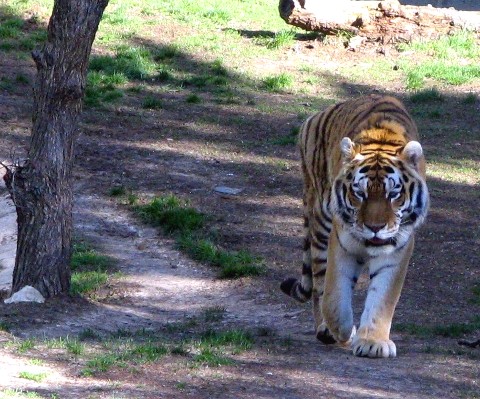
100,000 tigers living in the wild. Today, there are only 5000 in the wild.  Tigers now inhabit only 7%
of their original territory, which has shrunk by 41% in the past 10 years.
Those relatively few tigers that remain in the wild hunt wild cattle, deer and
pigs in isolated pockets of forested land in India, Sumatra, Eastern Russia in
southern China. Tigers are hunted illegally for pelts and for tiger parts that
are used in medicines (such as tiger penis soups).
Tigers now inhabit only 7%
of their original territory, which has shrunk by 41% in the past 10 years.
Those relatively few tigers that remain in the wild hunt wild cattle, deer and
pigs in isolated pockets of forested land in India, Sumatra, Eastern Russia in
southern China. Tigers are hunted illegally for pelts and for tiger parts that
are used in medicines (such as tiger penis soups).
 Tigers now inhabit only 7%
of their original territory, which has shrunk by 41% in the past 10 years.
Those relatively few tigers that remain in the wild hunt wild cattle, deer and
pigs in isolated pockets of forested land in India, Sumatra, Eastern Russia in
southern China. Tigers are hunted illegally for pelts and for tiger parts that
are used in medicines (such as tiger penis soups).
Tigers now inhabit only 7%
of their original territory, which has shrunk by 41% in the past 10 years.
Those relatively few tigers that remain in the wild hunt wild cattle, deer and
pigs in isolated pockets of forested land in India, Sumatra, Eastern Russia in
southern China. Tigers are hunted illegally for pelts and for tiger parts that
are used in medicines (such as tiger penis soups).
But did you know how many tigers live in United
States? 7,000 to 15,000 tigers live
in private roadside zoos, circuses, sanctuaries, farms and backyards in the US. Owners are often deluded into thinking that they contain the creatures, treating them like house cats, perhaps attracted by the challenge. Yet even house cats, whichhave been domesticated for thousands of years will reach out and swat their human companions. What happens when a six month old sixty-pound beast with claws and slicing incisors takes a swipe?
Are these privately owned tigers allowed to run in
large open areas and kept in good health? Not likely. Many tigers are kept in
cages much too small for them and they are “fed insufficient or inappropriate
food, such as canned dog food.”

The Natural
History article indicates that tigers are illegal to import, but they
reproduce easily in captivity. Therefore, it is easy to make more tigers, even
though many of them are inbred. Although federal law bans the interstate
shipment of endangered species for the pet trade, there are many loopholes in
the law. State laws are inconsistent, and some of them don’t even require
exotic animals to be registered.
Tigers are surprisingly cheap too. “The price tag
of a tiger cub-between $300 and $900-is comparable to that of a poodle puppy
registered with the American kennel club.” Tigers are sometimes given away
(when the owner realizes the enormous difficulty of keeping a tiger). The
article notes a one newsletter ad posted by a seller in Texas: “Free-two male
tigers and a half years old, likes women; one female tiger, six years old, likes
men and women; cages with cats.”
Imagine if we had taken a snapshot of the tiger
population 100 years ago and we could easily compare it to the tiger population
now. I suppose that is what I am doing with this post. Imagine the headline:
Tens of thousands of wild tigers no longer exist! Thousands of abused tigers
living desperate lonely lives trapped in tiny cages across America!If we saw
that headline dramatically comparing the tiger populations of two arrows 100
years apart, would we do something about the situation? Maybe and maybe not,
but it’s much more likely that we would do something if we could more easily see
the situation changing. When change is incremental and therefore not easily
noticeable, it is much less likely that we will do anything about a
deteriorating situation. This human difficulty of tracking slow change presents
a great danger to human populations.
Incrementalism makes critically important changes
invisible, unless we are in unusually patient sort of person who takes the time
to carefully track the slow changes of things that don’t seem to need
tracking.
I have a close friend who was in a highly strained
marriage. He happened to keep a journal over the years. His wife was an
alcoholic. His wife did not
become an alcoholic overnight. He did not notice this disturbing change in her
during any particular week or month. One day, he forced himself to sit down and
read ten years of his journal entries at one time. This allowed him to see,
finally, the slow and consistent deterioration of that relationship (and the
fact that things were not getting any better for the past few years). This
tracking of events through journal entries allowed him to dramatically see the
deterioration of the relationship. He filed for divorce after coming to this
realization, even though he had been there every day throughout this changing
situation, not fully appreciating the decline.
Here’s another example. How did it happen that the
United States has a critical shortage of water in many
locations? For instance, my youngest sister lives in Raleigh Durham, North
Carolina, where the metropolitan area typically has only a 50-day supply of
water available. Atlanta has a similar problem. Along the same lines, check out
this shocking image of Lake Mead. Put your cursor
over the top picture to see the difference in the water level in only three
years. Did these changes happen overnight? Absolutely not. Numerous decisions
have been made over the years to over-allocate the water supply. Another
incredibly distressing example is the lack of fish in the North Atlantic
Ocean, formerly an abundant source of food for millions of people.
Humans are simply not easily able to track subtle
changes over long periods of time without conscious effort and rigorous
analysis. This means that the numerous highly distractible humans up today are
flying blind with regard to some of the most important changes around them.
Carefully watching and listening to one’s local surroundings is no protection
from long-term dangers. Here’s a corollary: merely making short-term decisions
to satisfy one’s immediate needs will not necessarily bring about a benevolent
invisible hand. The benevolent invisible hand has an evil brother who that
squeezes people unmercifully, and often destroys them. Thus my impatience with
the many Pollyannas out there who think we can merely live our happy-go-lucky
local existences and everything long-term will simply take care of itself. Have
they taken the time to track all of the long-term changes brought about by our
short-term decisions? If they had, they would be distressed at many of the of
the long-term changes wrought by their alleged good buddy, the invisible
hand.
To what other critically important long-term
changes are we oblivious? They are too numerous to list. Here’s one to
consider. Perhaps the most important change to occur in America during the 21st
century was the mass migration of African-Americans from the rural South to the
urban North. It happened gradually over many years, so it did not make any
headlines like the wars, the misdeeds of celebrities and the periodic natural
disasters. As far as impacting American history, however, this human migration
cannot be underrated.
If only human beings had a constant craving to take
the time and effort to sift through longitudinal data and to do the necessary
analysis to conduct A/B comparisons. If we did, we would see how dramatically
life is changing over the decades and we would better appreciate what we are
doing to ourselves and what we are doing to our planet.
Here’s another dramatic example. Think about the
implications for the gradual increase in obesity among Americans. If you
haven’t noticed people getting fatter, it’s because it’s been so gradual over
the past couple of decades. Take a look at these maps, however, and you’ll see
that the change is as dramatic as it is dangerous to the health of
Americans.
Those of us who have been around for a few decades
as adults know that political campaigning has changed dramatically. Young
adults might not appreciate that Swift Boating is a nefarious art that has
developed over the years. It’s not that political candidates have not lied
about each other in the past, but they have never done so with the boldness and
calculation evident in today’s campaigns (even the Clintons are getting into
it). In fact, this relatively new ruthless method of fabricating and then
attacking character is all the more reason that many otherwise qualified people
would never consider running for office.
What else has been happening gradually, so
gradually that it takes number-crunching to notice it? How about the
substantial increase in the number of female college students and the significant decline in the number of
male college students? If that change occurred in one year, it would make
huge headlines, but that is not the case. What are the consequences for this
changing demographic? If we don’t notice the change, we won’t be able to ask
the right questions. If we don’t ask the right questions, we won’t address the
underlying problems.
There was no national headlines that the United
States would begin implementing a policy to torture its prisoners over the past
five years. If there had been such a headline, there would have been a huge
uproar (or is this wishful thinking?). As it is, the revelations were sporadic
(although sometimes dramatic) and smothered with official denials over many
months. Nonetheless, it is now clear that the Bush administration believes strongly in
torture and that many Americans have become complacent about the use of
torture, despite overwhelming evidence that we should be feeling great shame as
a nation.
Not all gradual changes are bad, however. Over the
past 25 years, the computer has become a standard appliance in most households
and businesses. It has become a key method of providing and receiving
information. This dramatic increase in the use of computers has been a gradual
change that has received very few headlines, despite the huge impact played in
our lives by the use of computers and the Internet. In an earlier post, I
commented on how different the practice of law was when I
started as a lawyer “only” 25 years ago.
What is acceptable as moral behavior often changes
gradually and imperceptibly. Imagine the outrage that would result if one
broadcasted some of today’s television shows one or two generations ago! The
violence and the sexual references would probably have had numerous people
marching in the streets. Speaking of sex, I do realize how I myself have
changed with regard to my attitude toward gays. When I moved into my urban
neighborhood 20 years ago, I knew very few gay people and I didn’t know any of
them well. In fact, I remember feeling a bit awkward around two gay neighbors
when I first moved in. Fast forward 20 years. Today, I rarely think it to be a
significant fact that someone is gay or not. What brought about the change were
the numerous occasions where I talked with, shared meals with and worked with
people who happened to be gay (as opposed to “gay people”). Somewhere, the fact
that someone was gay became very small my radar. I didn’t realize I was
changing in this regard over the decades, but I do now, given my focus on the
issue.
When things change slowly, we don’t notice them
changing and we forget that things used to be different than they now are. The
resulting obliviousness to slow change sets the stage for a faux sense of logic
and therefore justification. Many people feel that something is justified
simply because “it has always been done that way.” In fact, this principle of
doing things the way they’ve always been done has been elevated into the strange
legal principle of stare decisis. It is a strange principle and that it is an
amoral principal at heart, as I’ve argued before. Why should
something be justified simply because it’s been done that way before? It is a
principle that can justify anything, it even dangerous changes that have
occurred over a decade or two, a gradual enough change that people haven’t
really noticed the change.
Humans are creatures of limited attention and we need to
remind ourselves of this vulnerability repeatedly. If we don’t remind ourselves
of this susceptibility, we are at risk for drifting and deteriorating in ways
which we would never tolerate had we been more capable of noticing such slow
trends. Things that come to my mind are the virulent forms of religious and
political fundamentalism that are widely tolerated in America.
If we don’t stay vigilant, the things that we value
about our lives can and will deteriorate. Unless we take more care than we
currently are taking, the things that we value are at risk of going the way of
the tiger.

No comments:
Post a Comment